 |
|
|
Opus 198:
Opus 198 (Christmas 2006). Herewith, an antique anyule greeting, manufactured in my troubled youth, when both I and the rabbit were young and knew everything.
Casting a slight pall over
the festivities of the holidays is news of the deaths of two of cartooning’s
greats, the monumental Joe Barbera and the perennial Marty Nodell. We hope,
though, that our affectionate tributes to them both will lend their passing a
commemorative aura that is, in its own odd way, appropriate to the season. In
the same spirit, this installment of Rants
& Raves is being made available to all and sundry without requiring the
usual entry by subscription. Non-subscribers visiting this website can sample
our wares herewith in this single but complete dosage. Here’s what’s here, in
order by department:
NOUS R US
At
Hand, a Disney Retreat
More
Danish Fall-out
A
Drunken Conservative Hypocrite
Ugly
Pixelated Art in a New Comic Strip
Spider-Man
Gets the Batman Treatment
Fun
Home Triumphs
Graphic
Novel Challenges
AN ANIMATION COLOSSUS FALLS
Joe
Barbera Dies at 95
BOOK
MARQUEE
Bull
of the Woods Reprints
Will
Eisner Paperback Library Launched
DC’s
Archival Spirit, Volume 20
New
Biography of Walt Disney
FUNNYBOOK FAN FARE
Reviews
of Darwyn Cooke’s First Spirit and Outer Orbit
LIGHTING THE LANTERN ONE MORE TIME
Marty Nodell Dies at 91: A Fond
Remembrance
COMIC STRIP WATCH
Vintage
Strip Characters in Gasoline Alley
Johnny
Hart’s New B.C. Trouble
Ditto
for F-Minus and Close to Home
Agnes’
Christmas Spirit
COMIC
STRIP REPRINTS
Brevity
Reviewed
Onward,
the Spreading Punditry
The
Bush League Oedipus Complication and Tribal Justice
And
our customary reminder: don’t forget to activate the “Bathroom Button” by
clicking on the “print friendly version” so you can print off a copy of just
this lengthy installment for reading later, at your leisure while enthroned.
Without further adieu—
NOUS R US
All the News That Gives Us Fits
At
Disney Studios, hand-wrought animation may be on its way back. The Mouse House
dissolved its hand-drawn animation operation in 2004, but two staffers have
been working to get the company to return to its roots. And it seems they’ve
been successful. As of 2008, says Maira Oliveira at allheadlinenews.com,
“Disney will reportedly no longer be part of the computer-animation industry.”
But Pixar will continue in the high-tech rut it has worn for itself.
The Scandinavian dairy group Arla
Foods reports in irishexaminer.com that the boycott of its products in the
Middle East in protest to the Danish Dozen has cost the company millions
although sales have rebounded in recent months, approaching 60 percent of its
previous revenue. ... In Beirut, where they have enough trouble, an
advertising-media-marketing firm is taking the government to court for failing
to provide full compensation for damages to its offices caused during last
February’s riots over the Danish Dozen saith the Lebanon Daily Star. Hundreds of angry demonstrators set fire to the
building in which the Danish Embassy was lodged, the same building where the
media company had its offices. ... The fiberglass Garfield statue on the
Riverwalk in Marion, Indiana, has been beheaded by unknown vandals, reports
Whitney Ross in the Star Press. The
$8,500 statue, unveiled in October at the climax of a four-year campaign to
obtain statues in several Grant County communities, now stands hollow and
headless, dressed in workout gear with its thumb raised in the traditional OK
sign. ... Editor & Publisher notes that Mutts cartoonist Patrick
McDonnell has received an “Award of Appreciation” from the Sierra Club “for
making the public aware of environmental issues in his comic strip. ... In
another note, E&P reports that
Ohio State University’s Cartoon Research Library, founded in 1977 with the
papers of Milton Caniff, now has
over 250,000 original art cartoons in its collection, the largest such holding
in the country. “Caniff’s work will be one focus of the Library’s ninth
triennial Festival of Cartoon Art next fall, October 26-27, which will take
place in the centennial year of Caniff’s 1907 birth.” The Festival will have a
“Graphic Storytelling” theme. My massive biography of the famed cartoonist,
encyclopedically entitled Milton Caniff,
Terry and the Pirates, and Steve Canyon: Meanwhile..., will be out in time
for the festivities.
Bruce
Tinsley, who spews conservatively inspired anti-liberal hogwash in his
notoriously unfunny Mallard Fillmore screed, was arrested for drunk driving recently, his second such experience. At
ComicsCurmudgeon.com, blogger Joshua Fruhlinger was probably laughing an evil laugh
when he pointed out that Tinsley has used his strip to take swipes at arch
liberal Ted Kennedy for the senator’s past alcoholic achievements and so
deserves all the unfavorable publicity he can garner. “The hypocrisy issue has
come up,” said editoonist Ted Rall on his blog. But according to E&P, Rall
goes on to say that Tinsley’s drunk driving arrest “could happen to anyone who
knocks back three or four beers in an hour or two in a city without decent mass
transit—i.e., most people reading this. Speculation that he’s an alcoholic is
just that. If Tinsley has issues, he ought to be allowed the privacy to seek
help without being ridiculed by a Standard Issue American Media Pile-on ... cut
the dude some slack and let him figure out his life.” Nice thought, Ted; but
it’s too late here at the Intergalactic Rancid Raves Wurlitzer: as you can see,
we’re already celebrating with the sort of gloat we would have indulged over
Mark Foley if that issue hadn’t waned too much before our posting date.
Conservatives may be hypocrites, but hypocrisy is a decidedly American
political tradition.
United Media is launching Diesel Sweeties on January 8, and the
new strip by Richard Stevens has
already precipitated nasty remarks hither and yon. The “sweeties” are a robot
named Clango Cycotron and his human girlfriend, but interspecies romance is not
the cause of the criticism. It’s the drawing style—a pixelated construction at
about 10dpi, which makes the lines look like conglomerations of tiny but
visible squares. The inherent beauty of linework, in other words, is nowhere to
be seen. This is doubtless the first fruits of the work of Ted Rall, who United Media hired a few months ago to help in
acquisition and development. With Rall’s own blockhead drawing style as an
indication of his artistic preferences, we should have expected something like
this, but I was living in hope fostered by Rall’s otherwise admirably astute
attitudes on cartooning generally and politics particularly. A vain hope, as it
turns out: if you are looking for “modern, contemporary art” in comics, you are
looking, it seems, for clunky primitivism. And here, we have it in all its
computer-assisted glory. E&P published several of the comments about the strip generated at the
dailycartoonist.com: “Can’t speak for the writing, but the artwork is another
example of lowered expectations. ... Does ‘new’ or ‘edgy’ necessarily mean a
demise of the ability to draw?” Stevens can draw, I have no doubt; but his
choice of drawing instrument produces such ugly artwork that I have trouble
getting to the speech balloons to see what, if anything, is going on, hilarious
or not. Another commentator called it “an interesting experiment.” Another said
the strip was “like nothing else out there.” Yet another called it “a quantum leap
in the progression of newspaper comics. I can’t even remember a time when a
comic strip so unique was added to the comics page.” So the “unusual” is
sufficient qualification for artistic merit? Another enthusiast said: “You may
not like the art, but it is creative, experimental, and, yes, innovative. The
comic itself is an enjoyable read, and I think it can do fine. First off,
instead of being turned off by the pixel art, it will catch the eye of readers,
and they will try the strip. Chances are good it will get a following.” Alas,
this writer is probably right: it will get a following, which proves only that
we as a people have altogether lost the power of discernment in matters of
visual artistry.
Spider-Man is slated for Dark Knight treatment in a new series, Spider-Man: Reign. Written and illustrated by Kaare Andrews, the story has the Webslinger returning after a long
absence to a lawless city “desperately in need,” says Gavin Ford in the Star-Gazette of Elmira. But Peter Parker
hasn’t worn his blue and red costume in twenty years and he’s now an old man,
like Bruce Wayne in Frank Miller’s watershed graphic novel series, Batman:
The Dark Knight Returns. ... At ICv2.com, it is reported that J. Boylston
& Co. has acquired the companies owned by the late Byron Preiss—Milk & Cookies Press and Byron Preiss Visual
Publications—out of bankruptcy. “Boylston plans to continue publishing new
works of similar merit and will sustain the extensive backlist of science
fiction, fantasy, history, popular culture and military non-fiction titles.”
Good news. I sat next to Preiss at a comicon banquet a couple years ago without
knowing who he was. We started talking about graphic novels, and I listed the
recent ones I thought were the best. “Those are all mine,” he said and then
introduced himself.
Time magazine, which, E&P reports, has
published its first ever “Cartoons of the Year,” ten of them, at its website,
also listed Alison Bechdel’s Fun Home first among its picks for the
ten best books of the year, calling it “the unlikeliest literary success of
2006 ... a stunning memoir.” Fun Home also topped the first ever PW Comics Week critics poll for graphic novels. Runner-up was Jamie Hernandez’ Ghost of
Hoppers, followed closely by Linda
Medley’s Castle Waiting, Kevin Huizenga’s Curses, Scott McCloud’s Making Comics, and Bryan Lee O’Malley’s Scott
Pilgrim and the Infinite Sadness. And the Times of London said “the graphic book of the year is incontestably
Alison Bechdel’s unflinching, multilayered memoir. ... A complex love-letter
not only to her father but also to books and reading, Fun Home is luminescent with wit, lyrical prose, intelligence,
honesty and emotional truth.” We reviewed it here last time (Op. 197).
... Fun Home was one of two graphic
novels challenged at the Marshall Public Library in central Missouri recently.
The other was Blankets by Craig Thompson, another of the most
highly regarded of the genre. One patron said she wasn’t concerned about the
“content” as much as the illustrations (as if the two were somehow separate),
some of which depicted barenekkidwimmin and a nude couple embracing. The
library board removed the books until it can develop a policy about
acquisitions. Reporter David Twiddy at ca.news.yahoo.com says the American
Library Association knows of at least 14 graphic novel “challenges” (the term
for “attempt to censor and suppress”) in U.S. libraries over the past two or
three years. A back-handed compliment: “They reflect the increasing popularity
of the genre with libraries and patrons.” Reacting, the ALA has published
recommendations for librarians who seek to start their own graphic novel
collections but want to avoid controversy. “The recommendations largely explain
how to deal with challenges, but also suggest shelving graphic novels in their
own section or keeping graphic novels aimed at adults separate from those for
youngsters.”
The seemingly foreign language
spoken by Borat in the movie of that name is not, as we all suppose, Kazakh or,
even, gibberish. It’s Hebrew. Understandably, when the film is shown in Israel,
the audience gets an extra laugh every time Borat bursts forth in his “native
tongue.”
Fascinating
Footnote. Much of the news
retailed in this segment is culled from articles eventually indexed at http://www.rpi.edu/~bulloj/comxbib.html, the Comics Research Bibliography, maintained by Michael Rhode and John
Bullough, which covers comic books, comic strips, animation, caricature,
cartoons, bandes dessinees and
related topics. It also provides links to numerous other sites that delve
deeply into cartooning topics. Three other sites laden with cartooning news and
lore are Mark Evanier’s www.povonline.com, Alan Gardner’s www.DailyCartoonist.com, and Tom Spurgeon’s www.comicsreporter.com.
And then there’s Mike Rhode’s ComicsDC blog, http://www.comicsdc.blogspot.com
AN ANIMATION COLOSSUS FALLS
Joe
Barbera, half of the Hanna-Barbera animation team that produced such beloved
cartoon characters as Tom and Jerry, Yogi Bear, the Flintstones, and
Scooby-Doo, died of natural causes on Monday, December 18, at his home with his
wife Sheila at his side, according to Gary Miereanu, a Warner Bros. spokesman.
Barbera was 95. What follows is mostly the obituary written for the New York Times by Dave Itzkoff,
supplemented by information and an occasional phrase culled from other obits on
the Web (including Sue Manning’s Associated Press piece) and by consulting a
couple reference works on my shelf.
With his longtime partner Bill
Hanna, Barbera first found success creating the highly successful Tom and Jerry
cartoons. The antics of the archetypal cat and mouse team eventually won seven
Academy Awards, more than any other series with the same characters. The
partners, who had first teamed up while working at MGM in the 1930s, then went
on to a whole new realm of success in the 1950s with a witty series of animated
tv comedies. On signature televisions shows like "The Flintstones"
and "The Jetsons," the two men developed a cartoon style that
combined colorful, simply drawn characters (often based on other recognizable
pop-culture personalities) with the narrative structures and joke-telling
techniques of traditional live-action sitcoms. They were television's first
animated comedy programs. "From the Stone Age to the
Space Age and from primetime to Saturday mornings, syndication and cable, the
characters he created with his late partner, William Hanna, are not only animated
superstars, but also a very beloved part of American pop culture. While he will
be
missed
by his family and friends, Joe will live on through his work," Warner
Bros. chairman and CEO Barry Meyer said.
The Hanna-Barbera collaboration
lasted more than 60 years, during which time, the partners were reputed never
to have exchanged a word in anger. The critic Leonard Maltin, in
his
book Of Mice and Magic: A History of
American Animated Cartoons, described their enduring partnership this way:
“Hanna and Barbera saw something in each other [during their early
collaborations] and fused into a tremendous working team. Hanna’s background
was [with the studio of] Harman and Ising: cuteness, warmth, and the like.
Barbera’s forte was gag comedy. Hanna aspired to be a director and possessed a
keen sense of timing [due, Hanna said, to his grounding in math as an
engineer]. Barbera found his creative outlet in writing. They complemented each
other perfectly.”
"I was never a good
artist," confessed Hanna, who died in 2001. But Barbera, he said,
"has the ability to capture mood and expression in a quick sketch better
than anyone I've ever known." While Hanna took care of the technical side,
it was Barbera who did the visualizing.
Barbera was born on March 24, 1911,
in the Little Italy section of Manhattan and grew up in Flatbush, Brooklyn. His
love of drawing began at his Catholic elementary school in New
York
from which his mother withdrew him because he spent more time drawing pictures
of Jesus than studying him. Despite his ambitions as an artist, he was
persuaded to pursue a “proper” job, so at the age of 16, Barbera put his
drawing aside and took a job as a bank clerk. He also tried his hand at
playwriting and amateur boxing, but his sketching was an addiction. In his
spare time, he continued to draw, earning extra money submitting cartoons to
magazines. When he sold one to Collier’s,
he was persuaded to pursue a career as a cartoonist. In search of employment in
his chosen line, he wrote a letter to Walt Disney, then a rising star of
California's animation industry; Disney apparently promised to look Barbera up
on a subsequent visit to New York, but the proposed meeting never took place.
So Barbera began his animation career on the East Coast.
After a four-day stint with the
animator Max Fleischer, he began writing gags and drawing cartoon cels for Van
Beuren Studios in 1932. When the studio shut down in 1936, he found work at the
Terrytoon Studios in New Rochelle, N.Y., but one year later he left for Metro-Goldwyn-Mayer's
animation unit in Culver City, California. It was at MGM that Barbera met
Hanna, then a veteran cartoon writer and musical composer and lyricist. After
toiling on a short-lived series of animated Katzenjammer Kids shorts, the two
men decided to produce their own material.
Barbera recalled the moment in an
interview with Michael Mallory for the book, Hanna-Barbera Cartoons: "In desperation one time, we were sitting in a room waiting
for the place to fold, and I said to Bill: 'Why don't we try a cartoon of our
own?' "
Their first such project for MGM,
released in February 1940, was a theatrical short called "Puss Gets the
Boot" that featured a relentless cat named Jasper, perpetually frustrated
in his pursuit of a crafty nameless mouse eventually called Jinx. It was
nominated for an Academy Award. Over the next 17 years, the occasionally
sadistic antics that Barbera and Hanna devised for their anthropomorphic
rivals—rechristened Tom and Jerry—would earn MGM another 13 Oscar nominations
and seven statuettes.
The most significant aspect of the
Tom and Jerry history, however, is buried with Jasper and Jinx. No one at MGM
was very keen about Hanna and Barbera’s plan to make an animated cat-and-mouse
cartoon. Barbera recalled the reaction of the studio honchos: “How much variety
can you milk out of such a hackneyed, shopworn idea? How many cat-and-mouse
cartoons can you make?” Hanna and Barbera, in short, were given absolutely zero
support in their project. They had to develop it all by themselves, and, said
Barbera, to sell their idea, “we wanted to present something more than a
storyboard but less, of course, than a finished cartoon.” What they produced
that was more than a storyboard but less than a finished cartoon was what they
eventually called “limited animation,” a stripped-down animation technique
using less detail and movement, stock footage for backgrounds, and fewer
drawings. A seven-minute cartoon fully-animated required 14,000 separate
drawings; seven minutes of Hanna-Barbera limited animation needed fewer than
1,800—“but,” explained Barbera, “these were shot to length so that the film
produced by means of limited animation ran as long as the final product,
resulting in a [Jasper and Jinx] preview.” This benchmark experimental method
of 1940 would become the bedrock of the Hanna-Barbera operation sixteen years
later. During that sixteen-year interval, Hanna and Barbera used “limited
animation” to create full-length trial runs of every cartoon they did.
MGM put Barbera and Hanna in charge of
its animation division in 1955, but the studio shut down the unit two years
later. So the two turned to their side company, H-B Enterprises, which they had
established to produce animated television commercials, and began working full
time on television programs. For these, they resurrected the streamlined
animation technique they’d developed with Jasper and Jinx and had perfected
during the ensuing years. Limited animation was often criticized by animation
purists, but the method enabled the Hanna-Barbera shop to animate thirty-minute
stories on a weekly broadcast schedule. And they achieved almost instant
success.
“We went into limited animation
because there was no money,” Barbera said in his autobiography. “And because of
what we were doing, the entire [animation] business came back to work again.”
The first Hanna-Barbera series,
"The Ruff & Ready Show," had its debut on NBC in December 1957.
That was followed in 1958 by "The Huckleberry Hound Show," about a
powder-blue pooch who spoke and sung (badly) with a Southern drawl. That series
later won an Emmy and yielded a spinoff show for one of its supporting
characters, an Ed Norton-like bruin who showed up briefly in 1958 episode—Yogi
Bear, self-proclaimed as “smarter than the average bear.” Yogi and his shy
sidekick, Boo-Boo, debuted in their own show on January 30, 1961, accompanied
by other Hanna-Barbera favorites, Snagglepuss, the calamity-stricken lion,
forever announcing his departure with “Exit, stage left....,” and Yakky Doodle,
a dwarf duckling.
In 1960, Barbera and Hanna revisited
the template of Jackie Gleason’s famed “The Honeymooners” to create their most
popular series, "The Flintstones," a half-hour animated sitcom about
two families living in the Stone Age suburb of Bedrock. Launched on ABC on
September 30, it was the first prime-time animated program. Prefiguring “The
Simpsons,” it consistently ranked within the top 20 shows. Despite its fanciful
setting, "The Flintstones" hewed to sitcom conventions, using sight
gags and one-liners that centered on the domestic squabbles of the prehistoric
couple Fred and Wilma Flintstone and their next-door neighbors, the Rubbles.
Propelled by a catchy, brassy theme song, "Meet the Flintstones"
(introduced in the show's third season), and Fred's thunderous yell,
"Yabba-dabba-doo!" "The Flintstones" ran for 166 episodes
over six seasons.
In 1966, at the peak of the studio's
popularity, with Hanna-Barbera cartoons attracting global audiences of more
than 300 million, the two men sold their company to Taft Productions for a then
staggering $25 million. But they continued their own involvement in the
operation.
In the succeeding years,
Hanna-Barbera produced numerous prime-time, syndicated and Saturday-morning
cartoon shows, from 1962's futuristic family comedy "The Jetsons" to
the 1973 adventure series "Super Friends" to such 1980s-era toy
tie-ins as "Shirt Tales" and "Challenge of the GoBots." The
studio also produced eclectic projects like the 1978 television special
starring the heavy-metal rock band KISS and a 1973 film adaptation of E. B.
White's novel "Charlotte's Web." The partners’ final enduring success
was a take-off on a popular tv comedy series about a couple of blundering cops,
“Car 54, Where Are You?” Hanna-Barbera’s version starred a cowardly great Dane,
Scooby-Doo, and his four teenage buddies—Freddy, Daphne, Velma and Shaggy—who
tour the country in search of the supernatural under the series title,
“Scooby-Doo, Where Are You?” Starting September 13, 1969, “The Scooby-Doo
Show,” under one name or another, has been regularly re-broadcast in
syndication every few years ever since, becoming tv’s longest-running animated
series.
Barbera liked the freedom that
syndication gave filmmakers because there was no meddling by network
executives. “Today,” he once said, “Charlie Chaplin couldn’t get his material
by a network.”
In 1990, Hanna-Barbera was acquired
by Turner Broadcasting (now part of Time Warner), where it continued to produce
animated programming for syndication and for the Cartoon Network cable channel,
including "Dexter's Laboratory" and "The Powerpuff Girls."
In 1998, Hanna-Barbera's studios were moved to a Warner Brothers office
building, and by 2001, the company had been absorbed by Warner Brothers'
animation division.
Barbera remained active in
animation. He worked as an executive producer on such recent television series
as "What's New, Scooby-Doo?" He was also a writer, director and
storyboard artist on the 2005 cartoon "The Karate Guard," his first
theatrical Tom and Jerry short in more than 45 years. Though he was often asked
to explain the enduring popularity of his cartoons, Barbera was reluctant to
subject his life's work to close analysis. "To me it makes little sense to
talk about the cartoons we did," he wrote in a 1994 autobiography, My Life in 'Toons: From Flatbush to Bedrock
in Under a Century. "The way to appreciate them is to see them."
In the length of his career alone,
Barbera ranks as a legendary figure in the profession. And the characters and
comic series he created, not to mention the innovations of “limited animation,”
make the legend a colossus. Barbera’s influence can be found today in
prime-time animated series like "The Simpsons" and "Family
Guy" and in cartoons that satirize the Hanna-Barbera style, including
"The Venture Brothers" and "Harvey Birdman, Attorney at
Law." His own work continues to be seen on the cable channel Boomerang,
which broadcasts vintage Hanna-Barbera programming 24 hours a day. About
computer-generated animation, the new rage in animation, Barbera wasn’t
convinced. I saw a snippet of an interview on tv the day after he died in which
he said he felt computer animation lacked heart. An animator working on his
drawings by hand puts something into the art and the characterization that
Barbera thought was missing in animation done by machine.
BOOK MARQUEE
The
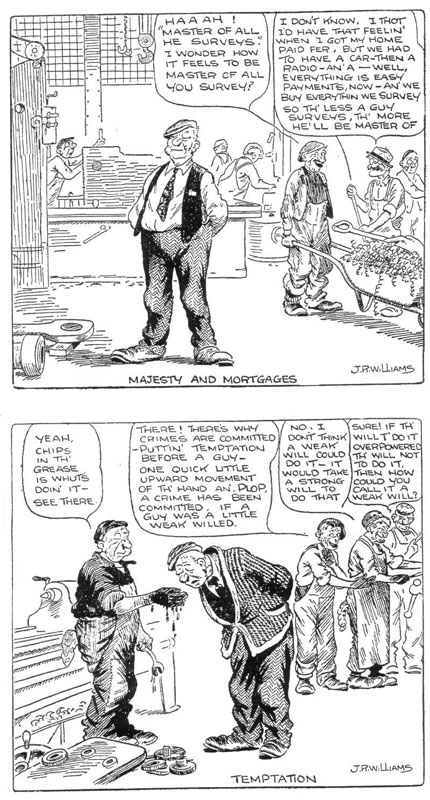
Bull of the Woods keeps on comin’ back. Algrove Publishing in Canada, the
“classic comics” imprint of Lee Valley, otherwise a hardware supplier,
continues bringing out volumes of J.R. Williams’
vintage single-panel cartoon, Out Our
Way. In his cartoon, Williams celebrated the life he had lived as a cowboy,
drifter, soldier (U.S. Cavalry), and machinist. Williams was born in Nova
Scotia in 1888, but he grew up in Detroit, where his family moved before he
entered school. He quit school at 15 and roamed the country, mostly Oklahoma,
which is where he cowboy’d and cavalry’d. After he married, he took a full-time
job with a crane company in Ohio. He didn’t start cartooning professionally until
he was 34 years old; he kept doing Out
Our Way until he died in 1957 at the age of 69. By then, his cartoon was
among the most widely circulated in the world. Syndicated by NEA, which
distributes its comics by packages to subscribing clients, Out Our Way was being sent to about 1,000 papers at its peak. Maybe
not all of them actually published the cartoon, but Williams enjoyed the income
from 1,000 subscribers whether they printed it or not. Algrove has published
tidy panel-cartoon-sized (6x7) paperback collections of Williams’ cowboy and
cavalry cartoons, and it’s now up to six volumes of “Bull of the Woods” books.
Williams described this character
this way: “The term ‘Bull of the Woods’ was borrowed from the lumber jacks. I
used it to describe a gruff, poker-faced man prowling among hundreds of machine
belts in a shop in Alliance, Ohio. Silhouetted against the hazy shop windows,
they had a certain resemblance to a dense woods. The ‘Bull’ was hard-boiled,
perhaps, but he was kind. He must have been, or I certainly should have been
fired. He said to me one day with fine sarcasm, ‘Pardon my rudeness. You’ve
been turning out two cartoons and one shaft a day on this machine. Couldn’t you
make it two shafts and one cartoon a day? This is a machine shop.’ And now,
when I have no shafts to do, I have a terrible time turning out one cartoon a
day.” Meanwhile, at W.W. Norton, the first
three volumes of the Will Eisner
Paperback Library landed in bookstores on December 5: A Contract with God, Life Force, and Dropsie Avenue (uniform editions, 7x10-inch size; $16.95), all
handsomely printed in exquisite reproduction of Eisner’s masterful
black-on-white. Each book has a few new illustrations, and Contract comes with a fresh introduction as well as the
introductions of the previous editions, beginning with a slightly revised
version of Eisner’s opening remarks for the first, Baronet, edition in 1978.
Faithful in both spirit and fact to the original, the latter paragraphs do not
use the term “graphic novel,” a genre and a term that Eisner would make popular
but which he did not, as is often erroneously claimed, invent.
In the same mail that brought the
Norton volumes came the latest DC
Archival Spirit, Volume 20, with an introduction by John Benson. This
period, January 1 - June 25, 1950, includes several Spirit stories that
employed art initially intended for other uses, chief among them, the “John
Law” material. A couple of the Spirit splash pages herein were supposed to be
John Law splash pages; Eisner, as always pressed to meet his weekly deadline, simply
re-tooled the artwork for the Spirit. Easy to do because although John Law has
an eye patch, he otherwise looks much like the Spirit. I’ve always imagined
that Eisner just whited-out the eye patch and inked in the Spirit’s mask, but
that, it turns out, isn’t what he did. The splash page for the March 12 story
here is one of the John Law make-overs, and the original Spirit story art
appears on the wall in the “Masters of American Comics” exhibit. When I saw it,
I was surprised to see that there was no whiting-out on the picture. John Law
had been copied, but the mask wasn’t added by tinkering with the John Law art
itself; the Spirit page had been completely re-drawn from the John Law
composition. This volume also contains the story in which the IRS comes after
the Spirit because he hasn’t paid any income tax. “I’ve never had to,” the
Spirit says, blithely, “—you see, gentlemen, I’m officially dead.” Close but no
cigar: the IRS guys say they’ve never seen a death notice for “the Spirit.” The
Spirit’s only way out is to reveal that he’s Denny Colt. But he’s reluctant to
do it. Will he? Or not? I’ll let you find out by reading the story.
A new biography of Walt Disney earned a mostly favorable
review from Anthony Lane in The New
Yorker (December 11). (Now, why couldn’t this review have run in the
so-called “cartoon issue” a few weeks ago to give that issue some text on
cartooning, some informational substance that it otherwise lacked?) The book,
by Neil Gabler, is Walt Disney: The
Triumph of the American Imagination (Knopf, $35), which I haven’t yet read,
but it promises much, if Lane is any guide. What Lane says about the book
suggests Gabler’s view of Disney accords with my own (see Hindsight here).
Moreover, I’ve liked Gabler’s other books, so the chances are good that I’ll
like this one. Finally, Lane disdains as a “psychological horror story” Marc
Eliot’s 1993 propaganda-laced enterprise, Walt
Disney: Hollywood’s Dark Prince, which I also scorned, so all the signs are
propitious for me to enjoy and appreciate Gabler’s Disney biography: I like the
author, and I like what the reviewer says.
Among Lane’s remarks are these about
Disney’s notoriously saccharine anthropomorphizing: “He is not humanizing
animals,” Lane says; “he is decivilizing ordinary life, which is a far more
subversive path to take, and sometimes he weeds out the human factor
altogether,” mining the “brute behavior that lurks behind it” for laughs. Lane
correctly sees the infamous strike at Disney Studio in 1941 as a watershed
event: “Disney would never again enjoy the same bond of trust with his artists,
or the same liberty to push animation to its limits.” Quality suffered as a
result, Lane continues: “To compare ‘Pinocchio’ [a pre-strike production] with
‘Peter Pan,’ released in 1953, is to pass from the embrace of magic to the
selling of a cute idea, from the densely detailed to the dismayingly flat. The
bestowing of life upon a wooden child is a perfect symbol of the animator’s
art, whereas the flying lesson that Peter gives to the Darlings has the air of
a cocky stunt.” Lane’s slightly jaundiced view of Disney is, I think, a
realistic and accurate one. But we, Disney’s audience, are as culpable as the
legendary entrepreneur for the sins he is alleged to have committed in the name
of entertainment—if, that is, blame is to be assigned, and I’m not sure it must
be. Says Lane: “Disney once claimed that his films were not made for children.
If so, that is both the most touching and the most frightening thing about him.
He saw the child in us all, and treated us accordingly. He took charge of
Neverland, and his chosen audience, orphaned by the rigors of adult life, was a
billion Peter Pans.” But Disney is scarcely the ogre that he appears in so many
portraits. Before the 1941 strike, Disney’s shop was “like a medieval guild,”
Lane says. Employees, “according to Gabler, [were accorded] ‘three sick days in
any given week with full pay before anyone investigated.’ Disney, Gabler
continues, ‘was constantly on the lookout for any employee who he felt might be
underpaid, and he would then instruct the payroll office to make a salary
adjustment.’” Disney promised bonuses to everyone who worked on “Snow White,”
and when the film appeared, he gave everyone “the equivalent of three months’
salary” to the tune of $750,000. Not a bad guy in those happy halcyon years.
A dubious highlight of Lane’s review
is his quoting from “Cartoon” in Robert Coover’s 1987 book, A Night at the Movies, a collection of
short stories. In “Cartoon,” Coover constructs a scenario in which cartoon
people interact with seemingly real people, infecting them with their animated
characteristics. The quotation, Lane says, illustrates the hilarious range of
flexibility animated cartoons offer. A cartoon woman comes upon the scene of a
traffic accident involving a cartoon man and his car and a cartoon policeman,
all paired with real personnel and vehicles. “The woman, winking at the real
man, bares her breasts for the policeman. These breasts are nearly as large as
the woman herself, and they have nipples on them that turn sequentially into
pursed lips, dripping spigots, traffic lights, beckoning fingers, then lit-up
pinball bumpers. The real policeman is not completely real, after all. He has
cartoon eyes that stretch out of their sockets like paired erections, locking
on the cartoon woman’s breasts with their fanciful nipples. She takes her
breasts off and gives them to the real policeman, and he creeps furtively away,
clutching the gift closely like a fearful secret, his eyes retracting deep into
his skull as though to empty it of its own realness, what’s left of it.” An
absolutely stupendous flight of fancy.
Among Coover’s earlier works is the
marvelous allegory about God and his savior son, The Universal Baseball Association, J. Henry Waugh, Prop., in which
Coover imagines a board game so convincingly that readers kept sending off for
it.
CIVILIZATION’S LAST OUTPOST
One of a kind beats everything. —Dennis
Miller adv.
A USA Today article about the
computer-generated version of E.B. White’s famous book about a pig and a spider
carried this beautifully bent headline: “Charlotte’s Web Gives a Rat Sass with
a ‘So Real’ Presence.” Wish I’d said that.
And in The New Yorker for December 18 is an article about the Bible
publishing business by Daniel Radosh which includes this piece of amazement:
“Research has found that ninety-one per cent of American households own at
least one Bible—the average household owns four—which means that Bible
publishers manage to sell twenty-five million copies a year of a book that
almost everybody already has.” Well, religion always had the best marketing
techniques.
FUNNYBOOK FAN FARE
The
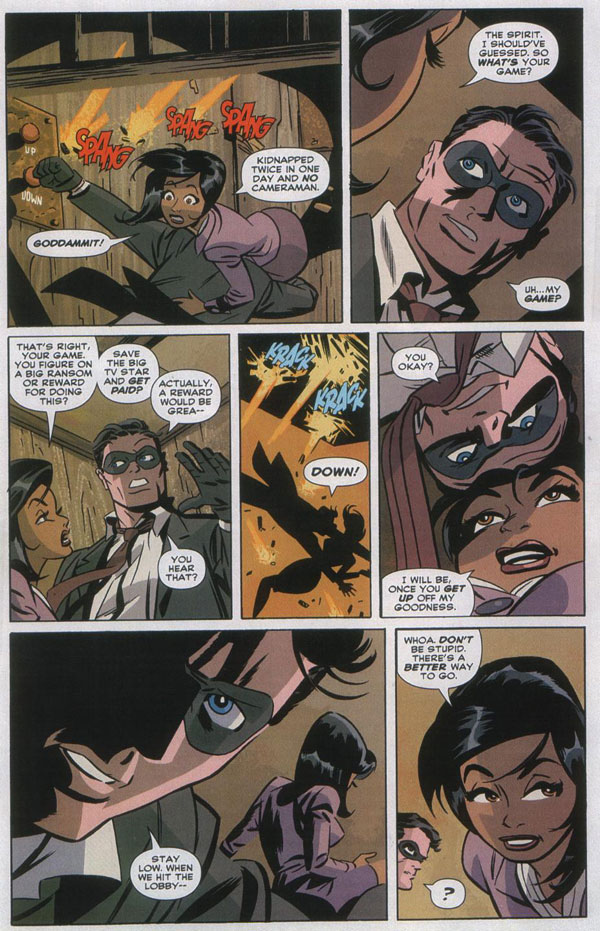
debut issue of Darwyn Cooke’s Spirit for DC Comics has, at last,
appeared. For the last year, I’ve been laboring under the delusion that it was
supposed to have been launched in January 2006. Clearly, I misread something
somewhere. Visually, Cooke’s work is much different than Will Eisner’s: Cooke draws with a clean, crisp bold line and very
little shading; Eisner deployed a less chiseled line and a lot of trap-shadow
embellishment. I’m glad, however, that Cooke has retained his own style: I’ve
always enjoyed his technique, and I’m not convinced that the best way to
reincarnate the Spirit is to slavishly imitate the mannerisms of the
character’s originator. So Cooke’s approach appeals to my own inclinations.
Cooke manages to evoke the noir quality of Eisner’s Spirit with a liberal
application of solid blacks, shadowing but not drenching the pictures. Nicely
done. Cooke’s storytelling style is
reminiscent of Eisner’s but his own withal. He does a good number of nearly
wordless sequences, but his characteristic maneuver is somewhat cinematic. In
an action sequence, Cooke gives us just the shortest glimpses of the incident
in progress: his camera shifts focus quickly from panel to panel, close-ups and
long shots alternate, catching facets of the action rather than its continuing
motion. This technique suggests with its almost frenetic fragmentation the
rapidity of the action, and it also keeps us partially in the dark, where most
noir events take place: while we know what’s going on, we don’t know all of
what’s happening—not every blow, every movement. Eisner’s stories had the same
kind of visual variety—long shots, close-ups—but not the same pacing. Cooke
effectively evokes the master while, with the same strokes, takes off in a
direction all his own. And with each glimpse of the action, we also get a quip
from the Spirit or Ginger Coffee. All in all, Cooke’s inaugural effort is more
about character and comedy than about crime, exactly in the spirit of Eisner.
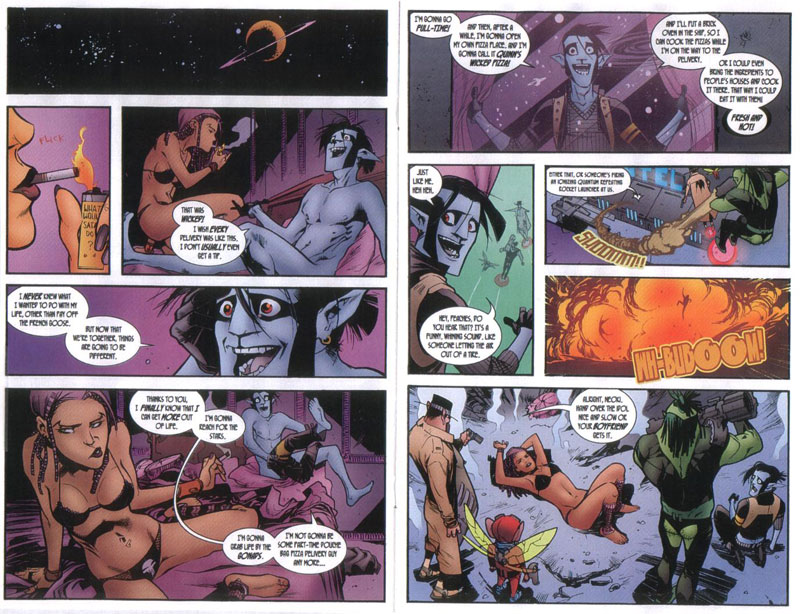
The lettering in the first issue of Outer Orbit is just enough off-beat to
make reading a trifle difficult, not a desirable circumstance in an
introductory issue. But the drawing is attractive in a crisp snappy way, and
the story, though convoluted, is laced with witty dialogue, oddly attractive
turns, and enough comedy to keep the pages turning. Written by Zach Howard, Sean Murphy and Reed Buccholz, with art by Howard and,
on inks, Murphy, the story, such as it is, introduces us to Quinn, a
blue-skinned alien humanoid of unspecified origin, and the heavily armored
Krunk, a galactic cop (or former cop), and Neoki, a refreshingly uninhibited
girl in short shorts on a space bike. I’m not sure what the object of all the
machinations might be. We start out with Quinn and Krunk trying to get an
ordinary coffee from an exotic Starbucks-like coffee shop and Krunk getting so
annoyed at the endless number of choices he must make that he blows the place
to smoking smithereens. Then they both go to join a poker game, where Quinn
tells a story about now he met and copulated memorably with Neoki. As he
narrates this tale, we shift to outer space where Neoki is zooming across the
galaxy on her bike. Somehow, she encounters Quinn and, without much effort,
seduces him into having earth-moving sex with her.
LIGHTING THE LANTERN ONE MORE TIME
Remembering Marty Nodell in Artists’
Alley
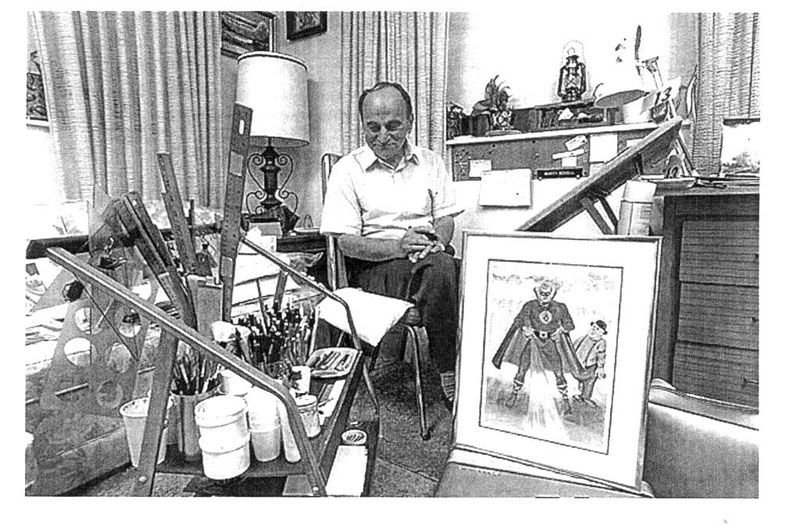
Martin
Nodell, the creator of the Golden Age comic book hero Green Lantern, sits at
his table in artists' alley during the 1994 San Diego Comic Convention, laying
color into the background of a drawing of Green Lantern. Rays of color radiate from behind the
character, and Marty's hand moves swiftly, back and forth, a new burst of color
at every stroke. He pauses for the
tiniest of microseconds at the beginning of each stroke—locating the point of
the marker precisely at the edge of the figure drawing—then he draws the point
away in a single sweeping motion.
"They wanted lots of
color," he says to a watching fan, explaining the garish colors of the old
Green Lantern's costume. When he
created the first Green Lantern before World War II, the costume had been
designed to capitalize on the colorful nature of the medium. Green tights, red blouse, purple cape,
crimson boots, yellow accents. Lots of
color.
THE
TABLES OF THE TYPICAL ARTISTS' ALLEY are six feet long and are lined up
together to form the sides of rectangles, four-five tables to a side. The artists sit behind the tables, and in
the hollow place in the middle of the rectangle, they stow their gear, which
they cart in daily like so many pack mules.
Some artists erect elaborate display
units for showing off their wares—towering structures of pipe and
foamcore. Others bring sprawling
portfolios of their work and open them up on the tables. Still others just heap their original
artwork on the table in front of them. Some sell the comic books they've done, too, placing a short stack of
them next to the artwork.
As the con wears on, the hollow
"storage area" in the middle of the rectangle of tables begins to
fill up with debris. On a second day,
artists bring more stuff—tackle boxes of markers, brushes, inks. Two or three portfolios. Easels. And the telltale evidence of their incarceration begins to appear: unable (or unwilling) to leave their
stations for long, artists bring their lunch and bags of snacks into the
confines—crates of chickens and goats and other barnyard edibles on the
hoof—and the litter slowly turns the hollow into a landfill.
When I go to a comic convention, I
usually hang my hat in artists' alley. For two reasons. First, by selling
a few "art prints" and original sketches, I earn the money that I
subsequently fritter away at the dealers' tables, buying comic books (Golden
Age, mostly) and a few other remnants of my Lost and Vacuous Youth. Secondly—in what will doubtless seem a
contradiction of the first reason—by staying at my artists' alley station for
most of the con, I reduce the number of hours and hence the amount of money I
spend amongst the exhibits.
And an incidental benefit also
prevails: in artists' alley, I have a
fellow cartoonist on either side of me, a circumstance that fosters
conversation and shop talk. In a
profession as traditionally solitary as cartooning, discourse with other
members of the inky-fingered fraternity is an activity to be savored.
Not that the conversation is
particularly brilliant or insightful. Sometimes it is; mostly, not. But it is fraternal, and that accounts for its great value.
During setup hours before the con
begins, we meet and introduce ourselves. We find out who we are and what we've done. We admire, briefly, each other's work. Then we set up our displays. After we establish boundaries, we make treaties:
"When you want to go to lunch,
I'll watch your stuff for you."
"Hey, thanks—I'll do the same
for you."
I sat next to Marty Nodell (and his
wife Carrie and son Spencer) in San Diego in 1994, and every time I went to the
restroom, Marty magnanimously gave me permission, usually without my asking for
it.
I’D
MET MARTY AND CARRIE a few years before in the lobby of the San Diego hotel we
were all staying in during the Con. They were waiting for the shuttle bus and
so was I. Marty, without preamble, asked if I was going to the Con, and when I
said I was, he and Carrie started telling me about their adventures attending
comicons for the past several years. Somewhere in the ensuing conviviality,
Marty said he’d created Green Lantern. But he didn’t dwell on this historic
fact: he slipped it in amid a generous sprinkling of funny, quaintly satirical
comments that, I would learn, always infected his conversation. Marty was a
funny man, a genuine wit. He almost never spoke at any length longer than a
sentence without saying something funny.
He was born November 15, 1915 in
Philadelphia and attended the Art Institute of Chicago when it was among the
most influential in commercial art and illustration. When he moved to New York,
he studied at another bell wether school, Pratt Institute. Late in the 1930s,
he began freelancing for some of the jury-rigged comic book publishers that
were cropping up in the wake of Superman’s debut in the summer of 1938. But
these companies didn’t pay well or, some of them, at all. Marty told Mark Evanier that “he got tired of
being stiffed by the smaller firms and decided to make an all-out effort to
break into the majors.” That’s when he called at the offices of National
Periodical Publications, now DC Comics, and invented the Green Lantern. He
worked on DC titles until 1947 when he left to work for Timely, now Marvel,
drawing Captain America, the Human Torch and the Sub-Mariner. By 1950, the
popularity of superheroes was waning, and Marty decided to go where the
pastures looked greener. He went into advertising, which, Evanier said, “he
found more satisfying, at least in terms of pay and stability.” By 1965, Marty
was an art director at the Leo Burnett Agency in Chicago; when he retired, he
and Carrie were in Florida, where he was doing advertising for the Palm Beach Post.
Marty might have languished
comfortably in the southern sun for the rest of his life except that he heard
about comic book fans and their conventions. Gary Colabuono, a collector and
dealer, recalls a day in 1978 when he received a phone call from a person he’d
never met. “I was working at a suburban Chicago newspaper,” Colabuono said in a
recent issue of Diamond’s online Scoop,
“and the employee newsletter ran a short feature on me. It was one of those
strange ‘ad salesman has weird hobby’ stories. A few days later, my phone rang
and the voice said, ‘Hello, this is Marty Nodell. You may not be aware of this,
and you may not even care, but back in 1940, I created the Green Lantern.’”
Marty had been doing some illustrations for the paper Colabuono worked for and
had seen the story about the collector. Said Colabuono: “The only thing I could
say to him was, ‘Where have you been?’” Colabuono, like most comic book fans of
the time, was eager to connect with whoever remained of the band of craftsmen
who had created the Golden Age of Comics. “From that moment on, we became close
friends,” Colabuono said, “and for the next 30 years or so, I watched in
amazement as Marty—with the invaluable assistance of Carrie and their son
Spence—created a third career for himself.”
Marty Nodell became a comic
convention celebrity. He made his first come-back appearance at the Moondog
dealer booth at the Chicago comicon in 1980. “He and Carrie were very
apprehensive about it,” Colabuono wrote, “but I’ll never forget the line that
stretched out the door of the dealer’s room at the old Ramada O’Hare. Carrie was
so funny. I remember her saying, ‘Gary—you were right: they do love him!’ And
Marty loved fans,” Colabuono continued. “He never got tired of talking about
his years in the comics business. He never got tired of doing sketches and
signing autographs. He was easily the most accessible and approachable comic
creator I’ve ever known.”
The diminutive Marty and ample
Carrie became fixtures on the convention circuit. At nearly every one during
the year, as Tom Spurgeon said at
his comicsreporter.com, Marty could be found “drawing for fans and charming
attendees with kind overtures, smart conversation, and the affectionate
interaction clearly on display between the artist and his beloved wife and
constant companion, Carrie. The larger comics community was in a way very
protective of the Nodells, coming to their aid if they weren’t treated well at
a show.”
NEXT
TO ME IN ARTISTS ALLEY, MARTY is hard at work. Crouched gnome-like over his drawing board, he works steadily all day
long, sketching the venerable Green Lantern in all manner of poses, coloring
the pictures, signing autographs, taking orders for drawings, and talking with
fans as he works. He seems tireless.
"You created Green
Lantern?" a young man says, standing open-mouthed before Marty at the
moment of realization.
Yes, Marty says; he was inspired, he
goes on, by seeing a switchman carrying a lantern through a subway tunnel. Green for go; red for stop.
Surely, there was more to it than
that, I think. And when the young fan
wanders off, I ask Marty about it. Was
it was true, as so many accounts had recently maintained, that Aladdin's lamp
figured in the story of the Green Lantern's creation? (Disney's Aladdin had just been released and probably stirred up
the creative juices of some reporters.) No, Marty says; Aladdin's lamp had nothing to do with it. And then he tells me the story.
WHAT
HAPPENED was that he had gone up to the offices of Max Gaines in early 1940 to
inquire about getting some comic book work. Gaines was then publishing a line of comic books under the imprint of
All-American Comics. Nodell had been in
New York for some time at this point, and he'd drawn comic book stories for
several publishers. At Gaines' place,
he talked to Shelly Mayer. Mayer told
him that they were interested in super heroes, and although they had nothing
for him to do at the moment, if he could come up with a super hero concept,
they'd be interested.
Nodell left, musing that if Mayer
had told him this, he must've told others—his friends, other cartoonists. So he, Nodell, better come up with something
fast. He took the subway home to
Brooklyn, where he lived with his brother and his mother. (They'd come to New York from Chicago after
his father died; Marty, now the family breadwinner, had theatrical ambitions
and talent as well as graphic art ability, and he knew his chances for
employment at these endeavors would be better in New York.) In the subway station, he saw a switchman
checking the track, carrying a lantern. The lantern shone red—danger, stop. After he'd checked the track and ascertained that it was in good order,
he changed his lantern to green by adjusting a glass plate. The "green lantern," then was the
"good lantern": it indicated
safety.
Marty pondered the green lantern
idea. At first, it seemed to him the
name of a story. As he rode homeward,
he turned over in his mind various far-eastern myths, conjuring up the legend
of the green lantern. The lamp, fashioned
by an old Indian in Singapore, was endowed with mysterious powers. It had enjoyed several incarnations through
the ages as one kind of lantern or another. Marty thought of the story of Diogenes and his search for an honest man,
bearing with him a lantern as he looked. Marty's new hero would carry the green lantern. No. That was too cumbersome. How
could this costumed hero do any fighting while carrying a bulky lantern?
As he continued to turn the matter
over in his mind, still recalling the myths and legends he'd read about as a
youth, Marty happened to think about the knightly heroes of Wagnerian
opera. And then it came to him. The Ring Cycle. Of course: his hero could
have a ring made from a portion of the green lantern, and that way, he could,
in effect, carry the green lantern with him wherever he went. And he could activate the powers of the
lantern through an act of will. The
green lantern itself would function as a battery: the hero would charge up his ring by exposing it to the green
lantern.
With that, the conventions of the
comic book superhero mythos kicked in—secret identity and colorful
costume. Willard Mason would be the
name of his hero. He'd be a professor
at Pueblo University. And he'd wear a colorful costume with cape and boots—no,
leggings like the Greek heroes—whenever he charged up his ring and went in
pursuit of evil-doers. He'd be known as
the Green Lantern.
Nodell drew up a couple pages,
pencils and a few inked images, to demonstrate his idea and took them to Mayer
and left them together with some concept sheets and story ideas. A few days
later, he phoned to see what had happened. Mayer said he was considering the idea. Within the week, he phoned Nodell and told him that Gaines wanted to see
him. Nodell had heard that Gaines was a
kind man—“gruff, but kind," he told me. He thought: he's probably asking
to see me in person in order to let me down easy. When he got into Gaines' office, Gaines was sitting at his desk,
thumbing the pages of the samples Nodell had brought in.
After a long silence, he said: "This is good."
More silence as he continued turning
the pages between his finger and thumb, flipping them sort of. Then he spoke again:
"Get to work."
The go ahead. The green light.
Nodell was off and running.
WHEN
THE GREEN LANTERN debuted in All-American
Comics No. 16, cover-dated July 1940, his alter ego was Alan Scott, not
Willard Mason. Scott was a civil engineer, not a college professor. And the
lantern was made in ancient China from a fallen meteor. The changes had been
introduced by Bill Finger, a now-celebrated but then mostly anonymous writer of
comic book tales in the early dawn of the medium. Finger had created Batman
from the fragments of Bob Kane’s imagination, and he did somewhat the same with
the Green Lantern. Marty was an idea man and an artist, not a writer; and
Shelly Mayer realized it and enlisted Finger’s help on Marty’s concept. The
extent of Finger’s assistance in creating the character has been argued over
for years—mostly, I suspect, because Finger’s role in the Batman saga had been
so long suppressed. The assumption was that he had a larger role in the Green
Lantern’s creation, too. But the allocation of credit for the creation of the
Green Lantern was finally certified last spring when the original art for the
first page of the first story was discovered in Marty’s home in West Palm Beach
when Spence was packing up his father’s belongings for the move to Wisconsin
(see Op. 190 for a bit more detail). “This shows that my dad was the
sole creator of the Green Lantern,” said Spence, adding that the differences
between the preliminary art and the published story also reveals the
“significant contribution” made by Finger. Thus, in one of Fate’s more
gratifying turns, Marty’s rightful role in the creative process had been
established before he died.
Marty’s health had been wavering for
several years, particularly since Carrie’s death in 2004. We all noticed, as
Colabuono said, that Marty “lost that special spark and twinkle in his eye when
she passed away.” It was as if in his performances of life, Marty had been
doing it mostly for an audience of one, his wife, who was always at his side.
And when his audience was gone, his performance suffered. Spence didn’t want to
leave his father alone in Florida as his health declined, so he moved him to
Milwaukee where, for a time, he lived with his son and family. As his health
continued to decline, however, Spence moved him to Tudor Oaks Health Care
Center in Muskego. He died there on the morning of December 9; he was 91.
“He would sit in our front lounge
and draw,” said Hope French, spokesman for the Center. “He first started
drawing the Green Lantern.” But he did other drawings, too, Spence told Amy
Rabideau Silvers at journalsentinel.com.
“He was still doing that until a
week or two ago,” Spence said. He laughed. “He had the habits of an artist. He
would get up late and go to sleep late. They got used to him at the Center.
After a while, they knew Marty Nodell would get up at 11 o’clock in the morning
and not at 7 [like everyone was supposed to].”
Spence continued: “One of his
proudest accomplishments was working on presentations for the Matador
surface-to-surface missile in the 1950s. He had a little tie clip that they
gave to everyone who worked on the project.” Marty was a member of the design
team that did early work on the Pillsbury Doughboy. “Some people credit him
with being the creator of the Pillsbury Doughboy,” Spence said, “but he wasn’t.
He did some of the first drawings and artwork for it, but the Doughboy wasn’t
his idea.”
MARTY
NODELL IS THE LAST TO LEAVE artists' alley. I'm packing up, stowing my stuff in a carrying satchel, and Marty is
still sitting there, working on a drawing. A fan is watching him, patiently, and finally asks the question:
"So what do you think of what
they're doing with the Green Lantern now? Do you know what they're doing?"
The character had been reincarnated
in 1959 as a completely different entity, albeit with the same Golden Age name.
Marty continues to draw, saying,
"Well, I heard a little. But you
have to remember, the character belongs to them. I don't have any say in what happens to him. That's just the way it is."
Carrie, always an active presence in Marty's Green Lantern enterprises, has the last word: "And did you know," she tells the fan, "that they sold Green Lantern No. 1 for $32,000 at the last auction in New York?"
COMIC STRIP WATCH
Over
at Gasoline Alley, Walt Wallet has
gone missing again. Just wandered off. And no sooner had he disappeared than a
government agent shows up to verify his existence. Walt’s 106 years old, and
the government wants to know, for sure, that he’s still alive—that it’s
actually Walter Weatherby Wallet who is cashing those monthly Social Security
checks, not some bogus Walt posing as the real thing. Walt’s housekeeper is
flustered because she can’t find the old man: she doesn’t know what we
know—namely, that Walt went to the Retirement Home for Old Comics Characters to
visit Mutt and Jeff. While watching Walt, we’ve seen cartoonist Jim Scancarelli’s stunning recreations
of Jiggs, Moon Mullins, the Yellow Kid, Happy Hooligan, Barney Google, the
Skipper of the Toonerville Trolley, Li’l Abner, Daisy Mae, Old Doc Yak, Pogo,
Paw Perkins, Andy Gump, Harold Teen, Spark Plug, Uncle Phil, Dixie Dugan,
Knobby Walsh, Krazy Kat, Smokey Stover, Freckles, and Mutt and Jeff—to name a
few (just showing off my Antique Comic Characters Identification Skills), the
most recent being the Rinky-dink kids from Winnie
Winkle. Mutt and Jeff, believing Walt is a fugitive, have successfully
smuggled him out of the Home. Almost. When last seen, he was careening down the
staircase on a gurney, headed right for the government investigator. Great fun,
kimo sabe—and Scancarelli’s having as much fun as we are.
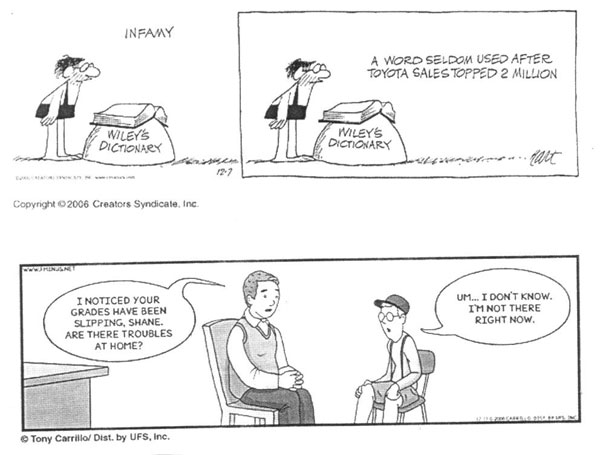
Johnny Hart’s in trouble again. But this time, it’s not an evangelical message in his B.C. strip that’s raised editorial ire. This time, ombudsman Bob Richter tells us at mysanantonio.com, it was his release for December 7, known in various climes as “Pearl Harbor Day.” And apparently, Hart was in trouble only in San Antonio. In the strip, which is reproduced down the scroll a bit, one of Hart’s cavemen is consulting Wiley’s dictionary for the meaning of the word “infamy,” which, we learn, is “a word seldom used after Toyota sales topped 2 million.” Toyota, it seems, has a big operation in San Antonio, so rather than offend the company, the San Antonio Express-News pulled the B.C. strip so that none of its readers, whether they work for Toyota or not, would be reminded (a) that Franklin D. Roosevelt, in calling for war on Japan after Pearl Harbor, said December 7 is a date that would “live in infamy” and (b) that Toyota is a Japanese auto manufacturer. Hart’s message, a sharply satiric one, ridicules our short memory as a culture: economic well-being (particularly, it might be assumed in this case, that of a local employer of hundreds) will blast from recollection even the date of an act so sordid that it was once thought no one would ever forget the date it happened. Apparently, Hart thinks, we’ve forgotten. Given the evidence he’s cited, maybe he’s right. He’s right, at least, about how things change over time. How long should we go on carrying that grudge about the Japanese, few of whom today were alive then (and none of the present population responsible then)? The editors at the Express-News didn’t think we should forget about it: they published a touching piece about the Japanese bombing of Pearl Harbor on the front page of the same issue they pulled B.C. from. I guess the editors wanted their readers to remember Pearl Harbor and the date of infamy but didn’t want them to connect the event commemorated on that day to a local employer and advertiser. Scrambling all over themselves to explain this curious logic, the editors remembered other occasions when they’d scrubbed a comic strip for inappropriateness. Said Terry Bertling, the assistant managing editor: “We pulled a comic stip about a school bus being a mobile classroom in which we learn the facts of life. On its own, it was fine. But immediately after a fatal school bus wreck in Alabama killed several teens, it could have looked like a comment somehow related to the news.” Right after 9/11, the paper pulled comic strips with twin tower skyscrapers in them or diving airplanes—“things that would have looked like they were making light of or ignoring the raw state of the nation at the time.” Well, sure. But that reasoning, perfectly sound in the situations described, scarcely applies to the B.C. strip, which was pulled, clearly, for fear of offending a big advertiser and local employer and maybe the people who work for Toyota. Nothing soaringly noble about that, I’m afraid. We all need skins just a little less thin.
On the other hand, the F-Minus strip shown above was more in
the category the Express-News editors
were bandying about. As we learn from Todd Quinones at cbs3.com, One paper
should have pulled the strip from the line-up. At the Philadelphia Inquirer it ran just a day after a 16-year-old youth
killed himself at a local high school. In a terrifying coincidence, the boy’s
name was Shane Halligan. The cartoonist, Tony
Carillo, who lives in far-off Arizona, was naturally shocked at the macabre
confluence of fact and fiction. He’d drawn the strip a month before it ran, he
explained in a letter to the paper, and could not have anticipated the tragedy.
“Neither I nor my distributor could possibly have had any knowledge of these
local events,” Carillo wrote. “It is a regrettable occurrence, and I hope that
those hurt by this incident can take solace in the knowledge that this
coincidence is simply that—a coincidence and nothing more.” The Inquirer’s editors didn’t know about the
suicide in advance either, but one of them, whoever is responsible for the
comics page, should have caught the strip when it was scheduled to run on the
day after the suicide, assuming the comics page is edited at all, as most
editors claim it is (looking for bad grammar, insensitive remarks, crude
language, etc.).
John
McPherson’s Close to Home panel
for December 18 achieved the dubious distinction of angering one segment of the
nursing population while pleasing another. The panel in question depicts an
emergency medical technician telling a patient who’s being loaded into an
ambulance: “You’ve got two options, bud. Mercy Hospital is 20 minutes closer,
but the nurses at Saratoga Hospital are really hot.” To properly grasp the
range of implications in this witticism, it is necessary to know that McPherson
lives in Saratoga Springs, NY. According to Editor
& Publisher, the executive director of the Center for Nursing Advocacy
in Baltimore was upset because the cartoon fostered a harmful stereotype of
nurses as sex objects. “This is not good for nursing,” she said, adding that
nurses are constantly mocked, degraded and disrespected on tv shows and in ads.
It’s not good for recruiting. One of the nurses at the Saratoga Hospital, on
the other hand, agreed that she and her colleagues “are very hot. That is how
we get our patients to come to Saratoga. We also provide great care.” McPherson
is looking for more of the same, apparently. He said the idea for the cartoon
originated in his own experiences at Saratoga Hospital. “I’m a single guy,” he
said, “and I figured if I put this plug in, I might actually be contacted by
some of the hot nurses at Saratoga Hospital.” The results aren’t yet in.
Tony
Cochran leapt unabashed into the anyule church-and-state fray in his strip Agnes, but Cochran isn’t coming out in
favor of state-sponsored Christmas decorations. No, the diminutive
blank-eyeballed Agnes is going one better. “I am going to come up with a winter
holiday that all humans, even the Feds, can celebrate with no repercussions,” she
said on December 18. “Everyone will have to shop and buy cards and have
parties—everyone!” “Will it still be on December 25?” her pal asks. “Nah,” says
Agnes, “—too many stores are closed.” Agnes’ “new winter holiday,” she asserts,
has “almost no embarrassing religious overtones—Kaloopahana. It celebrates the
wonder and majesty of Kaloopa, the bat-winged snow leopard. Long before there
were wise men,” she continues, “long before there were shepherds, there was the
fierce Kaloopa, queen of bat-winged snow leopards.”
Agnes’ plan would alleviate the
civic disorder brought on by the religious associations of Christmas, but we’d
still have the day off on Christmas Day: it was declared a federal holiday in
1871, and now enjoys the same national status as the Fourth of July, Memorial
Day, Veterans’ Day, and Thanksgiving. Christmas Trees, by the way—as they have
discovered, finally, in Seattle—are not religious symbols. They’re essentially
the residue of pagan practices—like the date, December 25.
Those of us who celebrate the season
in a cartooning mode can rejoice in the “Night Before Christmas” parody on the
Comics Curmudgeon blog. The re-written poem is laced with references to
syndicated comics; for instance, this stanza:
Mrs. Claus had been mixing Welbutrin
with booze
And gone shopping with Cathy for
undersized shoes
“It’s pathetic,” cried Santa, with
quivering lip,
“Like I’m stuck in some damn ‘Funky
Winkerbean’ strip.”
COMIC STRIP REPRINTS
Brevity, like F-Minus,
is a new comic strip that follows the Frank
and Ernest format—a single, strip-wide panel. There the resemblance to that
strip ends, but it continues in the fashion of Wiley Miller’s Non Sequitur, a single-panel strip that, until recently, deliberately avoided a continuing
cast of characters. Written, I assume (because his partner says he can’t draw
so he must be writing the strip) by Guy
Endore-Kaiser, who calls himself “Guy,” Brevity is drawn by Rodd Perry (or maybe he
just smoothes over Guy’s childish scrawls; they don’t say), who calls himself
“Rodd,” with two d’s, an affectation, surely, staged in competition with his
partner’s hyphen. The strip has about it a Far
Side aura. Here are two tin cans in the foreground, one saying, “You’re the
greatest can I’ve ever met. I just know we’ll grow old together on this fence
post.” In the distance, we see a cowboy loading his shotgun. And here’s a donut
hole next to a donut, the donut saying, “... and then some giant machine
punched a hole through my stomach, and that’s how you were born.”And then we
have a psychiatrist taking notes as a dog on his couch is saying, “I can’t
escape it, Doc—that feeling that I’m stuck in some lame New Yorker cartoon.” The lines are broken lines, almost dotted, in
the manner of Robert Mankoff, the
cartoon editor at The New Yorker. A nerdish-looking young couple are walking
along a path, and the be-spectacled fellow is saying, “By the way, I usually
sneeze in twos. So that’s another interesting thing about me.” In one picture,
a medieval-looking king on his throne and his courtiers are hovering in the
air, one of the latter gesturing to a man standing on the ground nearby and
saying, “May I present Sir Isaac Newton. He claims to have discovered something
big.” Two hikers come upon a river of lava flowing from the steaming volcano in
the background; one hiker says, “What do you think it tastes like?” The other
responds, “Sometimes, you have to find out the hard way.” As you doubtless
realize from just this pitiful sampling, these cartoons are nearly perfect
examples of the artform: neither words nor pictures make the same sense alone
that they do together. In fact, the pictures by themselves without the words
often don’t make any sense at all. You look at the picture and wonder: What’s
going on here? Then you read the caption, and it all makes perfect, hilarious
sense. Rodd’s drawing ability is adequate to this task. There is nothing wrong
with his rendering style, if you want to call it that. It depicts recognizably
the objects essential for understanding the cartoon. Rodd’s line is
triumphantly uninteresting—serviceable but without any particular distinction.
Boring, even. But wholly adequate, as I said. You can’t look at one of Rodd’s
drawings and misunderstand what it depicts. The art, in this feature, is in the
blending of word and picture for comedic effect, not in the drawing style. All
of these wonders can be found in the first Andrews McMeel reprint of the
feature, entitled, astonishingly, Brevity (128 8x9-inch pages in paperback; $10.95).
Onward,
the Spreading Punditry
OEDIPUS BETWEEN IRAQ AND A HARD PLACE
On
the eve of the appearance of the Baker-Hamilton Iraq Study Group report, George
W. (“Warlord”) Bush was still digging that hole for himself deeper, thundering
his deranged diatribe about not pulling the U.S. troops out of Iraq until we’re
victorious. While this sounds determined and resolute (his favorite
three-syllable word), it’s also rigid and stubborn, symptoms of dry alcoholism,
and it has left GeeDubya very little wriggle room: given the Iraq Study Group’s
recommendation that we bug out of Iraq after convening a meeting of Iranian and
Syrian and Saudi diplomats to clean up the mess in Mess-o-potomia, how can he
change course? Well, easy: just like ol’ George W. (“Waffle”) Bush has changed
course in the past. Simply alter the meaning of the words. Unbeknownst to all
of us, the definition of “victory” has doubtless changed, or is poised to
change. It now verges on meaning whatever George W. (“Whopper”) Bush says it
means. It could mean, for instance, whenever the temperature gets above 95
degrees. That’s when we’ll bug out of Iraq.
James Baker, a shrewd operator, is
the Bush Clan’s consiglieri. He and what Time (November 20) calls “the real A-team of Republican foreign policy
establishment”—that is, the members of his study group—have stepped in and
conducted “what amounts to a family intervention” to rescue GeeDubya from
himself. “Dad’s former aides [have presented] the son with a plan for saving
his presidency and, with it, some remnant of the family’s brand name.” Newsweek unearths a Baker bon mot from
some time past: “He once described Bush 43's core principles as “God and
exercise.”
The father-son relationship that
underpins GeeDubya’s so-called “administration” has been lurking in the
background all along. In the October 9-15 issue of the Washington Post National Weekly, Richard Cohen summarized much of
it in speculating about why GeeDubya ran for president in the first place: “He
wanted to best his father but also even the score for him. This score was a
twofold thing. George W. Bush wanted, in effect, to win the second term that
George H.W. Bush had lost (to Bill Clinton), and he also wanted to finish the
job his father had started with Saddam Hussein. If there is a better
explanation for why Bush—not necessarily the neocons around him—so fervently
wanted war, I cannot come up with it.” Father-son relationships are
complicated, Cohen continues. They are “fraught with competition, a sort of
canine sniffing that is suffused with both an edgy rivalry and an immense love.
... If I say that George W. Bush was out to both vanquish and redeem his
father, many a man will know what I mean.” Then he quotes Brent Scowcroft,
long-time national security advisor to the elder Bush, as quoted by Bob
Woodward in his State of Denial: “In
his younger years, George W. couldn’t decide whether he was going to rebel
against his father or try to beat him at his own game. Now, he has tried at the
game, and it was a disaster.” Everything he’s read, Cohen goes on, convinces
him “that Bush had no reason to run for the presidency other than to satisfy
some psychological compulsion—and had no accomplishment to his name that did
not stem from primogeniture. Especially in foreign policy, he was an ignoramus
who smugly thought that his instincts trumped experience and knowledge. What’s
even more appalling is that over and over in Woodward’s book, Bush sticks to
his losing hand, refusing to challenge his own assumptions—or, it seems, his
steadfast belief that his is a divine mission. ... Given the nature of the
problem, maybe it would be best if the father shed his reluctance and offered
his son some sharp advice. After all, it is now clear that the finest service
one president can provide another—not to mention his country—is to reassert a parental
role. The kid’s in way over his head.” And he’s taken us with him. Even more
alarming, we let him!
While we waited, in eager
frustration, the Baker Study Group report, we were amused almost daily by a
continuing debate over whether the armed struggle among Iraqis is Civil War or
not. I hadn’t realized it before, being a neophyte in anything but typing, but
apparently calling it a Civil War will permit the U.S. to withdraw its army.
The logic is a little shaky, it seems to me, but those who debate such matters
apparently agree. Maybe it’s some sort of international protocol. As long as the conflict is an “insurgency”
or “sectarian strife,” the occupying forces have responsibility to bring it
under control; but when the struggle is a Civil War, then no occupying force
has any responsibility. Then it’s okay to retire from the field and leave the
warring factions to their war. Since GeeDubya is wedded to “winning” in Iraq,
he doesn’t want to withdraw U.S. forces; so he won’t call it a Civil War.
I don’t know what to call it. A
“civil war,” in my imagination, requires opposing forces to face each other in
armed conflict. I’m not sure any of those armed thugs in Baghdad are facing any
of the other armed thugs: instead, each of the opposing bands of thugs sneaks
around killing off unarmed civilians who, the thugs allege, have some
allegiance to their foes. In other words, the “war” isn’t between armed forces
facing each other. The thugs seldom, if ever—and I haven’t heard of any
instances of it—face each other while pointing weapons. The struggle is not a
rebellion either because no one is in charge of the government, so there’s no
one to rebel against. It’s a guerilla war, a particularly nasty one in which
the citizenry seems bent on exterminating itself. It’s “civil” only in the
sense that the combatants are all citizens of the same society or state. Does
that make it a “guerilla civil war”? It certainly isn’t a civil guerilla war.
And if the former, does that, according to the quaint customs of international
decorum, permit us to leave?
The standard definition of a civil
war among academics has the purity of simplicity: groups from the same country
fighting for political control with a death toll of at least 1,000. While
Iraq’s disturbance surely qualifies under this rubric, the sheer simplicity
masks the actualities. The New York Times recently decided to let its reporters use the term “civil war,” but executive
editor Bill Keller issued a cautionary statement: “The main shortcoming of
‘civil war’ is that, like other labels, it fails to capture the complexity of
what is happening on the ground. The war in Iraq is, in addition to being a
civil war, an occupation, a Baathist insurgency, a sectarian conflict, a front
in a war against terrorists, a scene of criminal gangsterism and a cycle of
vengeance. We believe ‘civil war’ should not become reductionist shorthand for
a war that is colossally complicated.” And it won’t end easily. As Ted Rall, our omnipresence this outing,
pointed out recently in his column about Afghanistan, in a tribal society “each
fallen fighter leaves behind dozens of friends, relatives and neighbors eager
to avenge them and carry on the struggle. ‘Recruitment is not a problem for
them—not a problem at all,’ says Pakistani security analyst Ayesha Siddiqa.”
We made the mess in Iraq, so common
decency would suggest we ought to stay to put things right. But common courtesy
suggests that we be assisted in this endeavor by whatever indigenous government
there is, and I don’t think there’s much of that going on. My conviction is
that the so-called “government” in Iraq consists largely of power brokers,
either tribal warlords or their toadies, each grabbing as much wealth as
possible under cover of governmental policy. It’s not much different from the
way the U.S. Congress operates except that our system hasn’t yet learned to
tolerate armed looting in public. Looting in public is okay, it’s the armed
part that is, for the time being, frowned upon in polite political circles.
In Iraq, I suspect that they also
use government sanction as an cover for wreaking vengeance on rival tribes for
old or imagined slights and insults. These power brokers want the U.S. troops
around as a smoke screen behind which they can conduct these nefarious
operations, acquiring wealth by siphoning off government funds and acquiring
power by killing off the competition. If the U.S. withdraws, the semblance of
civic order will evaporate in days, and the power brokers will either have to
take to the field at the head of their armed forces and do battle in the open,
or they’ll have to take their money and run. They’ll do the latter in any case,
but they’d like the U.S. to hang around a little longer so they can squeeze a
little more from the national treasury. To keep the U.S. around, the chieftains
and toadies will continue to pretend to be conducting government, having
debates and voting every once in a while on some new law. Behind the scenes,
however, the looting and revenge-taking continue unabated.
If this sounds cynical, it probably
is. But that doesn’t mean I think Iraqis are less than capable human beings.
They are capable. But their capability expresses itself differently than we
express ours. Theirs is an ancient tribal society, and their capabilities
express themselves in tribal terms. We have difficulty understanding that. In a
tribal society—one that consists of several tribes—if a member of one tribe
injures a member of another, for example, it’s the injured person’s tribe that
has the grievance, not so much the injured party’s immediate family, as we
might expect, and the tribe expects compensation. Otherwise, war—or
assassination—will ensue. The tribe’s honor has been impugned, and it must
avenge itself, tit for tat, upon the injuring tribe, possibly initiating a
cycle of revenge-taking. Or not. Sometimes the injuring tribe simply accepts
its “punishment”: after the murder of one of its own satisfies the honor of the
other tribe, both crimes are forgotten and peace between the tribes is
restored. Sometimes a simple commercial transaction restores the honor of the
injured tribe. If the injuring tribe pays the injured tribe enough—in money or
property or deference—the injured tribe declares the hostilities over, and
tribal tranquility returns. That, as I understand it, is tribal justice. (My
understanding, I must point out, is somewhat elementary. I could be dead wrong
in the details, but I am reasonably sure that I’m right in general.)
Some readily recognizable semblance
of this ancient cultural practice still lurks in such places as Afghanistan and
Iraq. In our tradition, if someone is killed, murdered, we expect the killer,
the murderer, to pay with his life or liberty for the offense against public
order. Tribal justice, however, doesn’t necessarily exact that sort of
punishment. Recompense not retribution is often the measure of justice. Tribal
honor governs the proceedings: honor must be preserved, or re-established, at
all cost. We think in terms of the individual and the individual offender;
tribal societies think in terms of tribes. In such societies, the health and
welfare—the honor—of the tribe as a whole supersedes the well being of
individual members of the tribe. The individual does not exist as an
individual; he exists only as a member of the larger entity. As long as the
tribe prospers and its honor survives, all is well.
Since we don’t understand these
machinations very well, we don’t understand how the so-called government of
Iraq can persist as a nearly non-functioning entity. But it can because in a
tribal society, “appearance” is often more important than “reality.” Moreover,
in a tribal society the “real government” consists largely in portioning out
the boodle among the tribes according to their standing in the power structure.
The Iraqi government is doing that, I believe; and that’s about all it’s doing.
But that’s all that Iraqi society expects of it. Individually, citizens want
security, peace, prosperity and all the rest of the things GeeDubya is forever
extolling. But buried deep in the psyche of the citizenry is the tribal
tradition that individuals don’t count as much as the tribe as a whole.
Are Iraqis capable of democracy?
Intellectually, yes; psychologically, not yet. One of the first things we
learned in college freshman political science courses is that societies must
reach a certain stage in their “maturing” process before they can successfully
undertake democracy. By “maturing” here, I mean no particular value judgment:
the notion, probably fairly elementary, is that societies “mature” as they
progress from clans and tribes to nations and states, from chieftains and kings
to elected governors. If you impose democracy on a society not yet mature
enough, it fails: citizens demand services of their government that an infant
democratic government perhaps cannot deliver as fast as citizens expect. So the
citizenry rises up and overthrows the government for being inefficient. A
dictatorship quickly emerges, and to the extent that a dictator can supply
certain minimal public services, he survives. Iraq is scarcely a primitive
society: their technology alone is too sophisticated for that. But the tribal
tradition is strong. Whatever brand of democracy Iraq may eventually adopt, it
must embody the tribal tradition within. I’m not sure that’s ready to happen
yet.
Meanwhile, Happy
Kaloopahana, Festivus for the rest of us—or, better yet, Merry Christmas, the
federal holiday, which, by Constitutional fiat, is necessarily a secular not a
religious occasion.
To find out about Harv's books, click here. |
|
send e-mail to R.C. Harvey Art of the Comic Book - Art of the Funnies - Accidental Ambassador Gordo - reviews - order form - Harv's Hindsights - main page |